Friday, 21 December 2012

A2 - Equipment Needed for Filming

The equipment we used for our filming was:

Canon 600D camera
Canon EOS 600D - we used 3 Canon EOS 600D cameras in total because it enabled us to shoot three different angles of the same scene at once, or have two or three different scenes being filmed at the same time.

GoPro portable camera - our GoPro camera had a strap so it could be put on a person's head or chest to get a POV shot.

Tripods - we attached the Canons to tripods in order to enable us to get the camera steady, so the footage was as good as possible. If we decide later that we want footage to be shaky, we can do that later on FinalCut Pro.
GoPro portable camera

Props - Liver, plate, bowl, gun replicas, gas mask. We used a variety of props which were creative and allowed us to create a more interactive setting.

Torches - for the night shoot, we used several torches to create light. While the torches we used had headstraps, in the end we decided not to use them as head torches, preferring to carry them instead.

Handycams - sound recorders, we used them alongside the cameras to record diegetic sound that we could use in the soundscape of the trailer.

Liquid latex - we were going to use this to create fake wounds and injuries, however in the end we decided to avoid showing visible injuries because we noticed that not many shots were shown in horror trailers that showed injuries in any detail. In addition, none of us had enough experience to confidently create a realistic-looking injury.

We also had a smoke machine, but we didn't actually use it in the end because we didn't need it. We considered using it when our plot synopsis was a zombie idea, but when we changed our plot synopsis we didn't need to use it because it would set the wrong type of scene.

Saturday, 1 December 2012

A2 - Revised Plot Synopsis

Because of our choice not to use zombies, we had to devise a new plot. Due to our filming date coincidentally being 11 November, Remembrance Day, we decided to name the film Remembrance Day. Our new plot reads as follows.

Remembrance Day, 2012. Three teenagers discover an abandoned house when their car breaks down. When they enter the house, they discover a horror that refuses to let them leave. Can the teenagers escape before the mysterious being kills them all?

Friday, 16 November 2012

A2 - Target Audience - SurveyMonkey

Click here to take survey

To gather information about my target audience, I will create a SurveyMonkey to receive feedback from a target audience. This allows me to consider other people's opinions and views, and use them to adapt the idea that I am currently working on. By advertising it on my Facebook and Twitter pages, I gathered more feedback from a wider range of people.

Questions I have used include age and gender (to establish where each person fits in my target audience), favourite genres of film, what they feel to be the most important part of a trailer (so I know which areas to focus on), favourite horror films (so I can use them as style models), their favourite part of a horror film trailer, the best way they think can create tension in a horror film, and how much viewing a trailer impacts their decision to watch the film in a cinema.

Overall, the responses to my survey were useful. The majority of the participants were in the category of 15-19 year old males, my ideal target audience (unsurprising, as the majority of my Facebook friends and Twitter followers are roughly my own age). Horror, Comedy and Action films were the three most popular genres of film according to my survey responses.

With regards to trailers, the participants of my survey suggested that trailers should set up the plot of the film without revealing too much as to spoil their enjoyment. Building up the tension of the trailer was considered by my participants to be an essential part of a horror trailer, as was using a variety of visual effects (including POV shots and unsteady camerawork).
Question 1 - What is your age?
Question 2 - What is your gender?
Question 3 - What are your favourite genres of film?
Question 7 - What is the best way to create tension in horror films?
Question 8 - How much does watching a trailer affect your decision to watch the film?

Saturday, 27 October 2012

A2 - Editing Practice - Final Cut Pro

The main program I will use for editing my full task is Final Cut Pro. Final Cut Pro allows me to do more precise and frame-by-frame editing than I can with other software, such as iMovie. Final Cut Pro also allows me to add and edit sounds and music alongside the video, allowing for a more professional experience.

When I started trying to use the program I realised I had little experience with it. To get practice, as well as look at a style model for trailers, I edited the Dawn of the Dead trailer shot-for-shot, inserting cuts at every single cut throughout the trailer. Below I have put up several screenshots of my progress with the editing process.


While editing this trailer, I realised that a fade to black is one of the most common tricks used in horror film trailers. In this trailer, for example, at least 15 fades to black lasting roughly a second each are used, which is a large amount considering the trailer is only about 2 minutes long.

Friday, 12 October 2012

A2 - Technological Advances In The Horror Genre


Horror is a genre that does not require as many complex technological advances to be successful as other genres do. Examples of this are films like Paranormal Activity and the Blair Witch Project, which were both very successful without using much technology, using handheld cameras and cheap effects. However, some technological advances have been made which have affected horror films.

Using CGI to create a monster (Davy Jones as
portrayed by Bill Nighy in Pirates of the Caribbean)
CGI
CGI (computer-generated imagery) is one of the most commonly used tools in a major film director’s arsenal. It is basically using technology to create digital images that could not be possible to see or film around in real life. This is useful in horror, as it enables directors to create monsters that could not be portrayed by a man in a costume. However, the impact of CGI has been criticised by many fans of horror, as it is not necessary to be done, and many would consider it to be lazy and not necessary. They would consider it better to use prosthetics and other special effects, as it inspires more creativity in the director, to shoot scenes where (for example) a hand rips through a man’s chest from the inside. We would probably still find it a challenge to use CGI effectively in our trailer, because none of us have any major experience in using such software to create anything that looks realistic.

Science/Medicine
Technological advances in the real world have often inspired the plots of horror films. For example, you often get mad scientists “playing God” who create new monsters or diseases, with ideas inspired or taken from genuine scientific breakthroughs. Examples of this would include I Am Legend, and Frankenstein. The original film idea we were working with, before we changed our plot, was actually inspired by developments with genetic manipulation of crops, which in our story spreads a zombie-like disease when eaten. However, as our plot has changed away from zombies towards a serial killer, the prominence of scientific and medical advances has decreased.

Props, Prosthetics and Fake Blood
The “bread and butter” of any horror director’s toolkit, props and prosthetics have been used throughout time to represent scary things. In many cases, the prop or prosthetic is the “trademark item” of the monster of the film, and has immortalized the character, such as with Freddy Kreuger’s glove, Jason Vorhees’ hockey mask, Leatherface’s chainsaw and Dracula's cape and fangs. Some of these fairly-commonplace and mundane items have become permanently associated with a particular villain, and now if featured will often be as a reference to the original film in which they were used. We have used several props, including guns, an axe and a gas mask to create a more intimidating villain. In addition, fake blood was applied liberally to the "dead body" as well as the axe prop, to make it look more terrifying. However, we steered clear of using prosthetics, simply because none of us had any experience with using or applying prosthetics to people, and therefore it would probably end up looking foolish.

Thursday, 4 October 2012

A2 - Potential Locations

Below is a list of locations that I think might be good to film at, and reasons why it may be a good location.

The Beacon - I think the Beacon might be a good location to film at because it is very distinctive and recognisable, and it clearly stands out as a landmark of Bodmin. One concern is that there are often people walking around the Beacon, and therefore it may be a bit of a challenge to clear the area for an entire day when it is good weather to film.

A Graveyard/Cemetery - Filming a horror film in a graveyard is an incredible cliche, but it also creates an atmosphere of death that is harder to create at some of the other locations suggested. We may do some establishing shots at a graveyard, but no action or chase scenes because that would be disrespectful.

Shire Hall - Filming outside the Shire Hall, in the middle of town, might be a good idea in theory, but in practice, it would be difficult to clear the area of all people long enough to film all of the scenes we need.

Fair Park - Again, filming at Fair Park would be good in theory, with plenty of open space to film a chase scene or a fight scene, but in practice there might be too many people there to film it so it looks realistic. In addition, if we were to film in such a place, it would be almost impossible to clear the area and avoid having lots of people staring at what was going on.
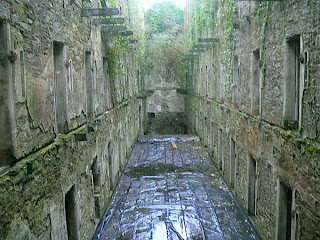
Bodmin Jail - haunted town landmark?
Bodmin Moor - Bodmin Moor has a reputation for being a spooky place, and would be an interesting location to film at. It is rugged and harsh landscape, which is good for creating a feeling of isolation. However, many of the good locations would be a long journey into the Moor, and running scenes may not be as practical in difficult weather conditions.

Bodmin Jail - Bodmin Jail also has a reputation as a haunted place, suitable for a horror film. It looks quite intimidating, and I feel confident that they would allow us to film some scenes inside the Jail if we gave them prior notice. However, given our focus on it being a serial killer rather than a ghost, this may no longer be as good an idea as it was for a paranormal horror film.

Camel Trail - Along the Camel Trail is a series of abandoned train depots, which would be a good location to do some filming at. They are fairly isolated, with few people lingering at them, and therefore would be a good place to shoot some action scenes.

Cycle Path - The Cycle Path has several large fields alongside it that might be useful to film a chase scene at. However, it is difficult to identify it as a wooded or isolated area, because it has a road and a railway line next to it, providing the characters with easy escape routes that we might not want them to use.

Church - Filming in a church is potentially disrespectful, but filming around the outside of a church can create a good background for action to take place at, or can create good establishing shots. If we head to a more isolated church, we can get some good shots to help set the tone of the trailer, with no real issues.

In the end, the majority of our filming was done at a friend's house, because it was fairly isolated and there were no issues with filming minors or unwilling people. We also filmed a small amount of footage at a parade on Remembrance Day, to link in with the revised plot idea of a killer attacking on Remembrance Day. This was also being filmed by other people, so there is therefore obviously no restrictions or concerns with filming the parade. Our night shoot was carried out in some woods nearby, in an isolated location that enabled us to do filming without being disturbed.

Tuesday, 2 October 2012

A2 - Film Institutions

In the media, there are a number of major institutions that control the industry. Three of the biggest conglomerates in the film industry are Time Warner, Disney and NewsCorp.

Time Warner is one of the major film conglomerates. It owns companies including Warner Bros. and New Line Cinema, and therefore is responsible for major money-making films such as Harry Potter, Lord of the Rings and the Hobbit. It also owns the major American broadcaster HBO, which owns TV series' such as Game of Thrones and also broadcasts a number of films.

The Walt Disney Company is considered one of the most recognisable of the film conglomerates. While it is associated frequently with cartoon animation from subsidiaries such as Pixar and Disney, it also owns subsidiaries that produce major blockbusters, primarily via Lucasfilm and Marvel Entertainment.

NewsCorp is mainly known now for its news companies, that have recently been in the media for phone hacking. However, it also owns the film company 20th Century Fox, and therefore has produced a large variety of films. In addition, it owns the broadcaster Sky, and therefore gains a large amount of revenue from showing films from other companies on any of its specific film channels.

I believe that the distributor of our film would be Paramount Pictures, which is a subsidiary of the conglomerate Viacom.